
Sources for Irvington Previous Residents
An address history should begin with an era table. The same house can appear in a current parcel record, an instrument held by the Essex Register, a regional directory, a released census, or a newspaper. The table keeps those sources from being treated as interchangeable. It also shows where the research stops: a record room may hold older material than the public interface displays, and an archive index may be incomplete even when the underlying record group survives.
| Source | Years It Covers | Where Held | What It Shows |
|---|---|---|---|
| Essex Register deed and mortgage record room | Deeds and mortgages recorded since 1637; online digitization cutoff unknown | Essex County Register and PRESS | Land instruments, transfer chain, recording dates, and legal descriptions |
| Irvington and Orange-area directories | 1889; 1916; 1929-1930; 1934, 1936, 1938, 1940; 1946-1967 | Rutgers, NJ State Library, and NARA holdings | Dated name or address snapshots where the volume includes the relevant listing |
| Federal census | Released schedules through 1950, under the 72-year public-release rule | National Archives and library research access | Household information tied to the census date and address context |
| New Jersey State Archives collections | State census years are uneven; 1875 is incomplete | State Archives, Trenton | Selected census, surrogate, vital, land, court, and naturalization material |
| Irvington property and permit route | Current public entry point; permit result fields are not confirmed | Irvington Property Information Portal and municipal departments | Parcel starting point, permits, and board-approval context where available |
Start with the source closest to the period being tested. A twentieth-century household may be easier to establish in a directory or released census than in an older deed. A transfer question starts with the parcel and Register record. If an online path ends, use the holding institution, the Record Room, or a focused records request rather than assuming the underlying file does not exist.
Irvington Previous Residents Start With a Parcel
The local starting point is the Irvington Property Information Portal, which directs a user to select Essex County and IrvingtonTWP and describes municipal property records, building permits, and board approvals. The published landing page did not expose a confirmed list of address, owner, block, lot, permit, status, or date fields. Use it to verify a parcel by address, then record what is actually shown instead of filling in fields from another system.
Keep three identifiers beside one another: the situs address, the tax mailing address, and the legal parcel description. The situs address is the physical location used by assessors, GIS, permits, and many notices. A tax mailing address can be elsewhere and does not establish who lived at the property. The legal description, often expressed through block and lot or a subdivision description, is the stable bridge when an older deed lacks a modern street number.
The NJGIN Property Explorer supports searches by address, county, municipality, block, and lot. Its parcel polygons are reference data, not legal surveys, and Daniel's Law can redact protected owner names. Use the map to orient the legal parcel, then use the official land-record route for a recorded instrument.
Note: Record the date of each parcel search because assessments and portal displays can lag a recorded change.
Irvington Previous Residents and the Essex Deed Chain
The Essex Register of Deeds and Mortgages is the land-record custodian for this step. Its Record Room states that it holds deeds and mortgages recorded since 1637. That long record-room statement is not an online coverage promise. The public-facing PRESS entry point was reachable during research, but its live search fields, image behavior, digitization cutoff, and fee details were not captured. When an online result is incomplete, ask the Register's Record Room about the instrument number, book and page, and plain or certified copy route.
A backward deed chain follows the property, not a name alone. Begin with the newest deed into the present owner and work back through the seller. Check the legal description on every transfer. A later deed may use a modern address while an earlier one uses a subdivision or lot description, so the chain needs a stable parcel reference before two similarly named properties are joined.
- Verify the current situs address and record its block, lot, parcel identifier, and legal description where available.
- In PRESS or through the Record Room, locate the most recent deed into the current owner. The buyer on that deed is the grantee.
- Copy the grantor, grantee, recording date, document or instrument number, document type, and the legal-description details.
- Search that earlier seller as a grantee in an earlier period, then compare the legal description before accepting it as the prior acquisition.
- Repeat the check backward. If an online index or image does not reach the needed item, use the Record Room copy route rather than inventing an online cutoff.
- Grantor
- The person or entity transferring an interest in the deed being read.
- Grantee
- The person or entity receiving that interest in the deed being read.
- Chain of title
- The documented sequence of land transfers for the same legal parcel, checked from one instrument to the next.
- Legal description
- The lot, block, subdivision, metes-and-bounds, or similar land description used to identify property in a recorded instrument.
Irvington Previous Residents by Legal Description
A street number is a helpful search point, but it is not the whole property identity. An older deed can omit the current number, while the legal description persists through a change in how the address is written. Compare the Register instrument to block and lot, subdivision language, mapped parcel position, and any available plat. Zoning, ward, and tax maps can orient the search, but none replaces a recorded survey.
No Irvington-specific street-renumbering date was documented in the research. Do not assign a renumbering year to explain a mismatch. Instead, preserve the older wording, check the legal parcel, and use dated maps or municipal records only when the source supports the connection.
The township's official maps page provides tax maps, a view-only zoning map, and a 2010 Census ward and district map. Ward labels can appear in local records. They help orient an address historically, but do not create a household list.
Past Residents in Directory and Census Pairs
Land ownership is only one layer of an address history. For past residents, add the dated household layer from a directory, a released federal census, a newspaper, or a probate and obituary trail. The verified directory runs are uneven: 1889 Essex, 1916 Oranges and Irvington, 1929-1930 Orange-area microfilm, the 1934, 1936, 1938, and 1940 Oranges volumes, and Rutgers' 1946-1967 Irvington reels. A missing directory year must not be read as a vacant house or a missing household.
Use the directory years to frame the census rather than forcing a one-to-one match. The federal census has a 72-year public-release rule, and New Jersey state census material is uneven, with the 1875 material incomplete. A directory may provide the best located address snapshot between released schedules. The collections and entry-reading rules are detailed with the Irvington city directories.
- Choose the closest available directory year for the address or surname and copy the page or image reference.
- Check the nearest released federal census, keeping its census date separate from the directory publication year.
- Compare name spelling, initials, street number, spouse notation, nearby listings, and age or household clues without treating any one field as final proof.
- Use an obituary, newspaper notice, deed, probate file, or map to test a move, departure, death, or changed address.
A criss-cross or reverse directory, when the volume contains one, starts with the street and number rather than the surname. It can be valuable for an address question, but each volume's own layout and abbreviation key must be checked before a notation is interpreted.
Irvington Previous Residents and Probate Endpoints
Probate can help close a former-owner or family trail after a directory or deed points to a death. The Essex Surrogate FAQ asks for the deceased person's name, date of death, and last address if known for a mailed search. A positive result letter may identify a docket number, attorney, executor or administrator name and address, page count, and copy cost. It is an estate record route, not proof that a person lived at every address associated with an estate.
The Surrogate lists a $10 fee for each mailed name search and $3 per page for copies. It also describes free public-computer searching and a free vault search during business hours, subject to exceptions including adoption and guardianship. That makes an in-person check a useful alternative before paying for a mailed search when the precise decedent and date are known.
Use sensitive estate and family material narrowly. A probate name, a recorded property instrument, and a historical directory become more persuasive when their dates, legal parcel, and identity details agree.
Irvington Previous Residents and Vital Records
New Jersey vital records can help test a family-history lead, but they have their own access rules. The New Jersey Department of Health genealogical-record rules use 80-year birth, 50-year marriage, and 40-year death thresholds, with the person deceased for genealogical requests. Certified copies require identity and a qualifying relationship, while certifications are informational. Irvington's local registrar is the first contact for an event in the municipality, and the state office issues state copies and certifications.
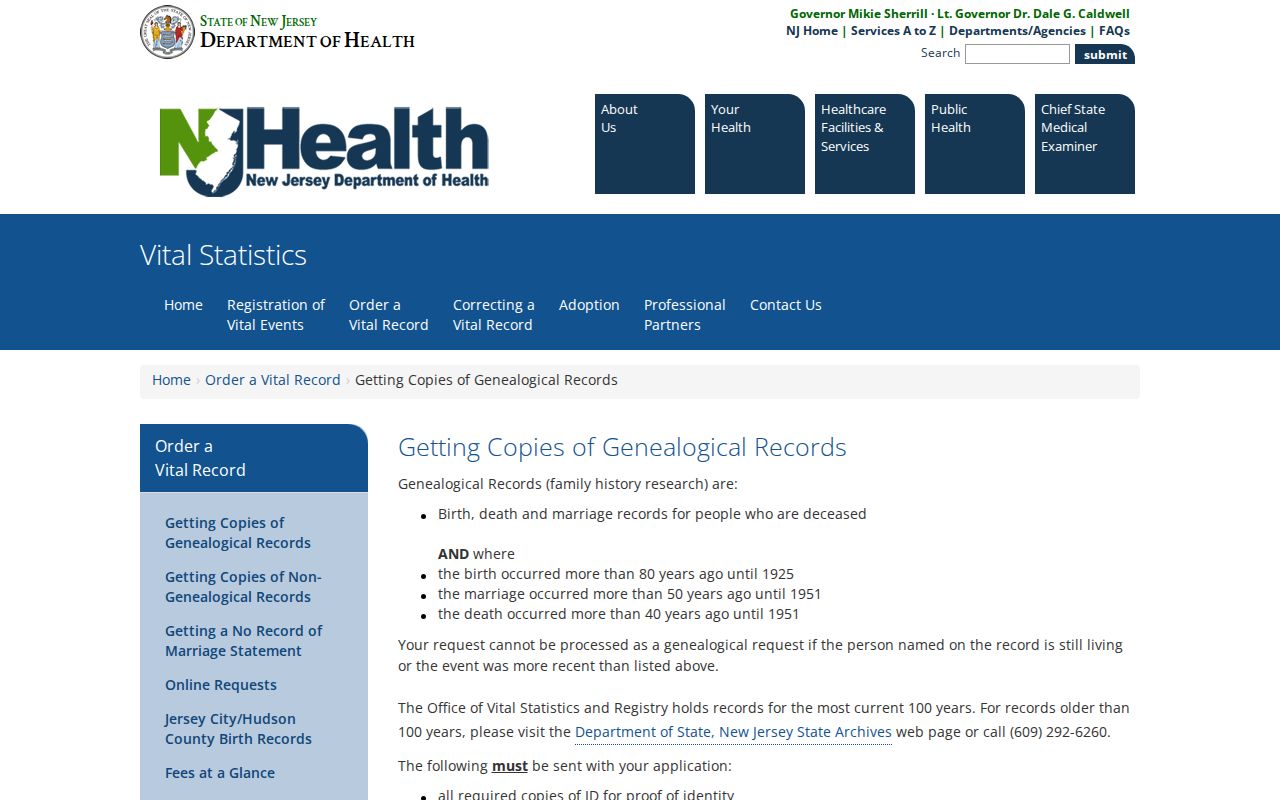
The rules help distinguish a legitimate family-history request from a general search for living people. State Archives holdings cover older historical records, while the Department of Health controls current eligibility. Record the source, event type, and requested record range before submitting a form.
Note: A directory, obituary, or deed can guide a vital-record request, but it does not replace the eligibility rules of the issuing office.
What Irvington Previous Residents Records Prove
Each source has a narrow use. A deed establishes a recorded transfer, not every person who occupied a home. A parcel record can identify an assessed owner or mailing address, but it is not a current-occupancy guarantee. A directory is a dated listing, not a title opinion or a complete household roster. A GIS polygon is reference data, not a legal boundary. Keep the source label with the fact it supports.
Protected addresses can be limited by New Jersey's Address Confidentiality Program and Daniel's Law. Court, vital, and election records also have separate confidentiality rules. A focused request should ask the correct custodian for a defined record, date range, and public field rather than seeking unrelated personal data.
Irvington Previous Residents When the Trail Stops
Do not fill a gap with a guess. The Register's Record Room reaches back to 1637, but the online PRESS digitization cutoff and image coverage were not documented. The Irvington portal advertises permit and board-approval categories, but its public result fields were not confirmed. No current official Irvington house-history guide, municipal permit archive guide, or local library special-collections catalog was located in the research. No Irvington-specific Sanborn item was located in the official Library of Congress search.
The fallback route is specific: contact the Register Record Room for an identified instrument; ask an Irvington department for a narrow address and date-range record; consult Rutgers, the State Library, NARA, or Newark Public Library for historical holdings; and ask the State Archives about its relevant collection. For a municipal government record, Irvington's electronic intake and custodian route operate under the New Jersey Open Public Records Act, P.L. 2001, c. 404, as amended, N.J.S.A. 47:1A-1 et seq. Requests should identify the record type, date range, address, block and lot, or instrument number.
The archive path moves across Irvington, the Newark Hall of Records, Trenton, and university or federal collections. That geographic spread is normal for an Essex County address history. Keep a log of searched years, exact titles, requests, replies, and copy references so later research begins with the documented stop rather than repeating it.