
Irvington City Directory Holdings
The surviving Irvington city directory record is a set of named runs, not one complete annual series. Rutgers University supplies the strongest direct Irvington run: its genealogy guide identifies four microfilm reels of directories filmed for Irvington Public Library, held at Alexander Library as ALEX M/FILM 2784. The reels cover 1946 through 1967. That shelf reference gives a researcher a real place to begin, but it does not prove that each year was printed or that every household appeared.
Earlier coverage broadens into Essex and the Oranges. The New Jersey State Library directory inventory is a finding aid for the 1889 Essex volume, the 1916 Oranges and Irvington title, and later Price & Lee volumes. The inventory should lead to a catalog check before a scan, lending option, or local shelf is promised. NARA separately identifies an Orange-area microfilm run that includes Irvington for 1929 and 1930.
| Collection | Years | Where Held | Access |
|---|---|---|---|
| Moffat's Essex County Directory Outside the City of Newark | 1889 | NJ State Library inventory; Montclair Public Library holder noted | Finding aid and catalog confirmation |
| Directory of the Oranges, Irvington, Livingston and Millburn | 1916 | NJ State Library inventory | Verify the volume and holding in the catalog |
| Orange-area directory microfilm | 1929-1930 | National Archives finding page | Orange run includes Irvington |
| The Oranges, also Irvington, Livingston, Roseland Directory | 1934, 1936, 1938, 1940 | NJ State Library inventory | Physical or digital availability must be confirmed |
| Irvington directories filmed for Irvington Public Library | 1946-1967 | Rutgers Alexander Library, ALEX M/FILM 2784, four reels | On-site or controlled library access |
No official source found a definitive first Irvington directory or a final printed year. A blank year is therefore a collection gap, not evidence that a person or household disappeared. Record the volume title, year, page, and whether the item was read as a name listing or an address listing before drawing a conclusion.
Irvington City Directory Years in Context
Older records can carry several place labels. Irvington became an independent municipality on March 27, 1874, after being part of Clinton Township. Voters rejected Newark-annexation proposals in 1903 and 1908. Those facts explain why an older catalog, newspaper, or regional directory may be filed under Essex, Newark, Orange, or a combined Oranges title rather than under a modern municipal label alone.
| 1889 | The located Essex directory gives county and place context outside Newark. |
|---|---|
| 1916 | A combined Oranges, Irvington, Livingston and Millburn volume creates the next verified snapshot. |
| 1929-1940 | The NARA Orange run and the 1934, 1936, 1938, and 1940 Oranges volumes provide uneven, regional coverage. |
| 1946-1967 | Rutgers identifies the four-reel Irvington set filmed for Irvington Public Library. |
Irvington's municipal history also records a free public library by 1915 and an earlier network of trolley, telephone, water, and civic institutions. Those changes help date a street or organization named in a book. They do not turn the directory sequence into an unbroken run, so a research note should keep the actual volume year beside the event being investigated.
Note: Use the title printed on the volume, even when it groups Irvington with nearby municipalities.
How Irvington City Directory Entries Read
An Irvington city directory entry normally starts with a surname and given name. It can add a spouse or household notation in parentheses, an occupation or status, and a street address. The Library of Congress notes that city directories were commonly arranged by surname and could also use address or telephone arrangements. Their coverage was irregular, and compilers could work door to door or rely on local sources. That makes the entry a useful dated lead, not a complete account of a home.
The available research does not include a viewable page from the 1946-1967 Irvington reels. A faithful inventory is safer than an invented transcription. Read the abbreviation key in the same volume before treating a short mark as a family relationship, a residence status, or a business detail.
| Name | Surname and given name, sometimes with initials or a spouse or household notation. |
|---|---|
| Status or occupation | A work, social, telephone, boarding, or business-related notation may appear when the volume used one. |
| Street address | House number and street are often the bridge to a deed, map, newspaper, or census search. |
| Address-order entry | A reverse section can place the street and number first, then identify the recorded occupant. |
| Volume key | The book's own abbreviation key controls the meaning of shortened street, widow, boarding, or telephone marks. |
- Criss-cross directory
- An address-order section that starts with a street and number, then lists the recorded occupant or listing.
- Householder index
- A name-centered arrangement that helps locate an entry before checking its address and surrounding listings.
- Abbreviation key
- The volume's explanation of its own short forms. Photograph or note it before interpreting an entry.
Irvington City Directories by Address
For an old house question, look first for an address or criss-cross section in the actual volume. Start with the street and house number, then copy the listed name exactly as printed. A reverse section is especially useful when a surname is not known, but it is not guaranteed in every directory. The source must be checked volume by volume.
Old deeds may use a subdivision, block and lot, or other legal description instead of the modern number. When a street number does not bridge cleanly to a land record, keep the directory notation separate from the legal parcel reference. The modern, address-keyed record route belongs on the Irvington By Street directory; historical books work best as dated snapshots alongside that record trail.
Do not assume an owner named in a tax or deed record was the person listed in a directory. A listed person may be an occupant, and an address can change, be omitted, or be rendered differently by a publisher.
Irvington City Directory Gaps in Newspapers
When no directory year survives, newspaper holdings can supply a narrower but useful date window. Newark Public Library's archival inventory identifies Irvington newspaper microfilm, including Irvingtonian for 1872, Irvington Record for 1894-1895, Irvington Progress & Hilton Publisher for 1912, Irvington News & Vailsburg Enterprise for 1903, and Irvington Times for 1941 and 1943-1945.
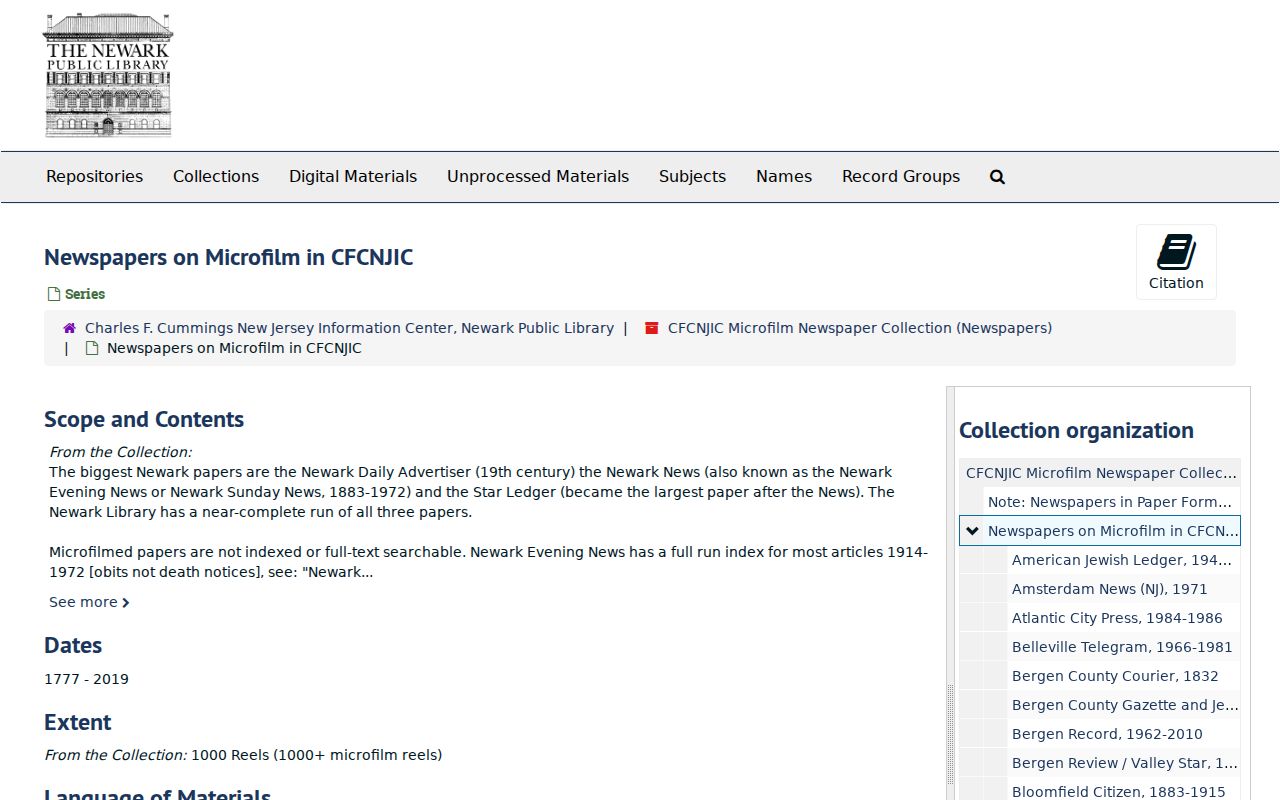
These holdings can help test a directory lead through obituaries, school notices, civic appointments, address changes, and social notices. Read the original issue where possible. Optical text can miss initials, hyphens, and local names, and a newspaper mention is not a substitute for the directory page it helps locate.
Following an Irvington City Directory Household
A household trail works best when it is built in pairs. Begin with a known name or address in one verified volume, then look to the preceding and following available years. Copy spelling, initials, spouse notation, status, number, street suffix, and nearby entries. A slight spelling shift can be a publisher choice, while a new number may require checking a map or legal description before it is called a move.
- Find the surname or street in one identified Irvington or regional directory volume and record its page or image reference.
- Check the closest earlier and later available runs, rather than assuming every calendar year exists.
- Use an address-order section when present to compare the same house number and nearby listings.
- Pair the directory year with the closest released federal census, noting that federal schedules follow a 72-year public-release rule.
- Test a departure or appearance with a deed, obituary, probate record, school source, or original newspaper notice.
A missing name can reflect a move, death, omission, initials, a different listing arrangement, or a gap in the books. Federal census and state-census coverage also have limits. New Jersey state census years are uneven, and the 1875 material is incomplete, so a directory or newspaper may be the only located household snapshot for a particular interval.
Note: Preserve a citation for each page so a later reader can distinguish a directory clue from a confirmed identity.
Irvington City Directory Archive Routes
Rutgers Alexander Library, the New Jersey State Library, NARA, the Library of Congress, Newark Public Library, and the New Jersey State Archives each cover a different part of the trail. Rutgers holds the identified reels. The State Library inventory helps locate regional volumes. NARA documents the Orange-area microfilm. The Library of Congress offers catalog and directory-method guidance, but it does not perform staff name searches or loan a complete directory through interlibrary loan.
The Irvington municipal history points to Irvington Public Library files and several local-history titles, including works by Alan A. Siegel and the Irvington Historical Society. That is a useful local lead, but no current official Irvington, New Jersey genealogy or obituary catalog was located in the research. Ask the institution about a specific year or title rather than assuming an unlisted collection is available.
For broader historical records, the New Jersey State Archives provides research access to selected vital, census, naturalization, surrogate, land, and court groups. Collection coverage and whether an item is indexed or imaged vary by record group.
What Irvington City Directories Cannot Settle
A directory entry does not establish title, prove every household member lived at the address, or override a protected address. A parcel polygon is reference data rather than a legal survey, and an assessment or directory listing is not a title opinion. Use a directory for a date-stamped lead, then compare it with the custodian's record that answers the next question.
New Jersey's Address Confidentiality Program and Daniel's Law can limit address visibility in government-held material. Older print sources can also contain errors, omissions, and stale entries. Treat a match as one part of a documented record trail, especially when names are common.
Irvington City Directory Research Beyond the Shelf
Archives hold more than directories. The New Jersey Historical Society points researchers to maps, gazetteers, newspapers, late-nineteenth- to 1930s-era "mug books," family collections, and a card catalog. These materials can explain a street, a civic organization, or a local surname, but no catalog result alone proves that a particular person appears in a collection.
Essex records also show why a missing web result should be handled with care. The State Archives reports that Essex County Jail prisoner records from 1931-1950 were returned in 2019 through a document-recovery effort. The example is not a directory collection, but it is a practical reminder to use archives, microfilm, indexes, and formal copy requests together when a digital search comes up empty.